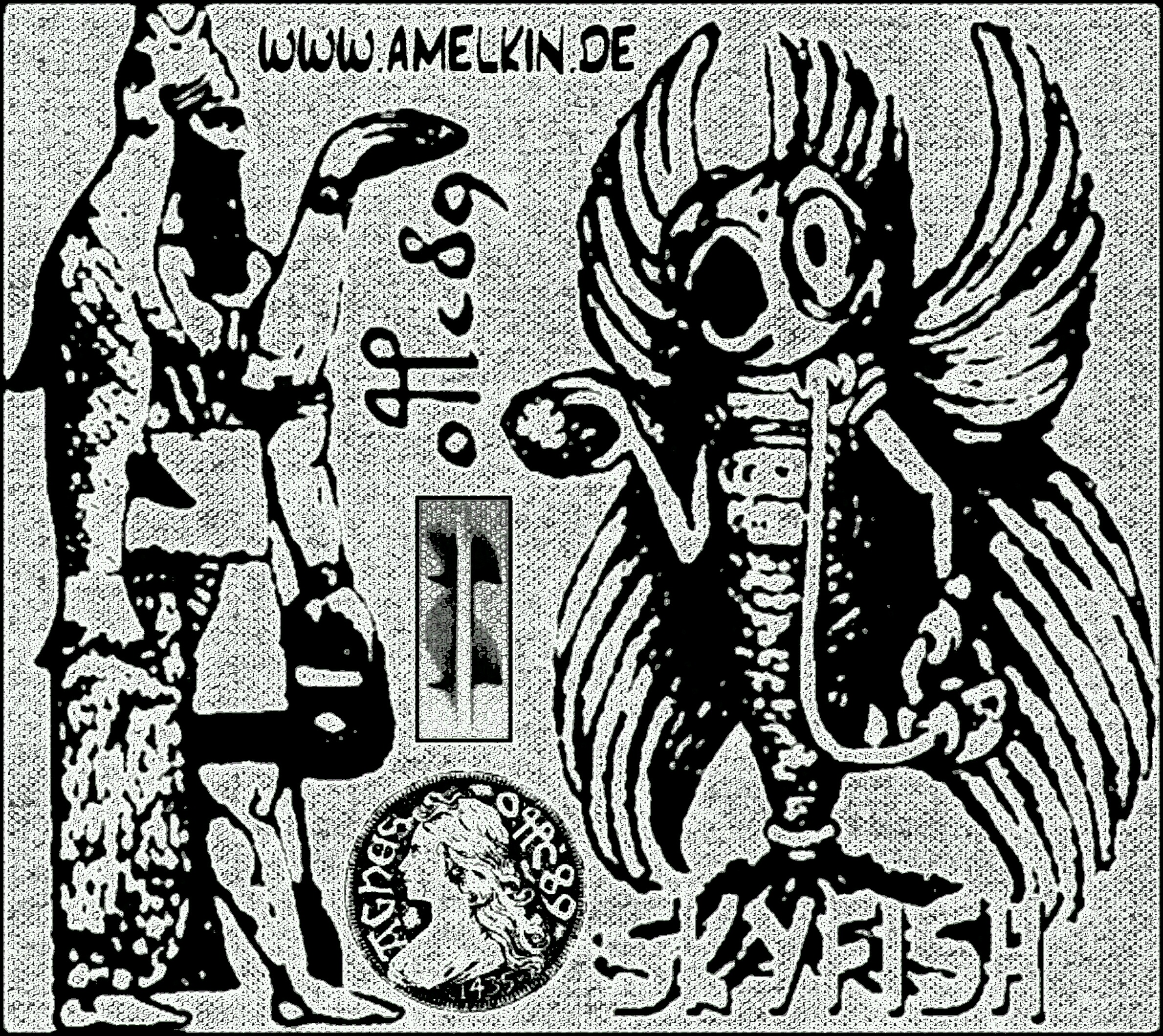
The culture of TILAPIA goes back to Ancient Egypt. TILAPIA is said (as a fish-goddess) to accompany and protect the sun-god Ra on his daily journey across the sky. In ancient Egyptian art the fish-goddess Tilapia was depicted either as a fish (tilapia), or a woman with a fish emblem or crown on her head. She was a goddess of life and protection. Tilapia was represented by the hieroglyph K1 ("in", "int", "jn") of the Gardiner List. The fish-goddess Tilapia is associated with the region of Annu: the constellations of Pisces, Cetus and Eridanus. Tilapia was considered as a daughter of the Sun, and this is very interesting, while the neighbouring sun-like star "epsilon Eridani" (which could be called "Tilapia") is smaller and younger than our sun. The Goddess of Life and Protection could protect our Sun again!
Literature
1. "DES POISSONS DANS LE CIEL (A la Recherche de Nemo dans l'Ocean du Ciel)"
2. Chimits, Pierre (1957). "Tilapia in Ancient Egypt"
3. Dambach, Martin; Wallert, Ingrid (1966). "Das Tilapia-Motiv in der altaegyptischen Kunst"
4. Hodjash, Svetlana (1991). "Zum Motiv Tilapia auf altaegyptischen Kunstwerken in den Museen der Sowjetunion"
5. Germond, Philippe (2004). "De l'observation naturaliste a la representation imagee: les deux "poissons de la renaissance", symboles de vie et de regeneration"
6. "Tilapia". "Hatmehit". "Hathor". Articles in Wikipedia
7. Zivie-Coche, Christiane (2009). "Hatmehyt, le Tilapia, le Lotus et le Ba de Mendes"
8. Capel, Anne K. and Glenn E. Markoe, ed. Mistress of the House, Mistress of Heaven: Women in Ancient Egypt. (New York: Hudson Hills Press, 1996), 70.
9. Leitz, Christian, ed. Lexicon der Aegyptischen Goetter und Goetterbezeichnungen (LAGG, OLA 110, Band 1). (Peeters, 2002), 68-77. Sacred Animal Section.
10. Pinch, Geraldine. Egyptian Mythology: A Guide to the Gods, Goddesses and Traditions of Ancient Egypt. New York: Oxford University Press, 2004.
11. Tyldesley, Joyce. "Isis: Great of Magic," in The Penguin Book of Myths and Legends of Ancient Egypt. (Penguin Books, 2011), 211.
12. Zabkar, Louis V. Hymns to Isis in Her Temple at Philae. (London: University Press of New England, 1988), 51 and 53.
13. Gerald Massey. "The Natural Genesis, Band 2"
SUPPLEMENT
VOTE FOR THE FISH-GODDESS TILAPIA! NAME THE EXOWORLD "EPSILON ERIDANI"!
LET TILAPIA ENTER THE RIVER "ERIDANUS"! VOTE FOR THE DAUGHTER OF THE SUN!
VOTE FOR THE FIRST AMONG FISH! VOTE FOR THE GODDESS OF LIFE AND PROTECTION!
The culture of TILAPIA goes back to Ancient Egypt. TILAPIA is said (as a fish-goddess) to accompany and protect the sun-god Ra on his daily journey across the sky. In ancient Egyptian art the fish-goddess Tilapia was depicted either as a fish (tilapia), or a woman with a fish emblem or crown on her head. She was a goddess of life and protection. Tilapia was represented by the hieroglyph K1 ("in", "int", "jn") of the Gardiner List. The fish-goddess Tilapia is associated with the region of Annu: the constellations of Pisces, Cetus and Eridanus. Tilapia was considered as a daughter of the Sun, and this is very interesting, while the neighbouring sun-like star "epsilon Eridani" (which could be called "Tilapia") is smaller and younger than our sun. The Goddess of Life and Protection could protect our Sun again!
TEXT IN RUSSIAN
"Несут нас Времени фрегаты - всегда вперёд, ни йоты вспять... Мы были рыбами когда-то... И станем рыбами опять..." В нас живёт рыба... И, возможно, нас породили инопланетные разумные рыбы-оанны, создав на базе некого проточеловека своё детище на Земле - шумеров, первых истинных людей, ведущих свой род от Адапы - шедевра генной инженерии оаннов... И они же - шумеры - завещали нам главнейший принцип выживаемости: "плыть по течению" или "mitschwimmen", что по-немецки звучит более ёмко и лаконично... Этот же принцип используется создателями цивилизации шумеров - рыболюдьми "У-Ан" (или "аннунаками") при путешествии сквозь кротовые норы... И этот принцип примирит все правительства и станет спасением для нашей прекрасной планеты, когда всё человечество начнёт синхронно двигаться ("плыть") в одном направлении!..
У меня иногда возникает такое ощущение, что в некоторых параллельных мирах, в которых мы одновременно существуем, мы являемся рыбами, и этому есть объяснение. Дело в том, что системы красных карликов являются самыми распространёнными и самыми долговечными системами во Вселенной. Но по ряду обстоятельств (планеты в зонах обитаемости захвачены приливными силами; красные карлики могут "вспыхивать"), высокоорганизованная жизнь на экзопланетах в этих системах возможна только в водоёмах, обеспечивающих защиту от неблагоприятных условий среды. Этот же принцип распространяется и на спутники планет-гигантов, такие, как например Энцелад (спутник Сатурна), на котором под коркой льда существует тёплый океан, в коем благополучно могут существовать такие экстремалы, как окуньки Natron tilapia, вполне способные со временем эволюционировать в разумных рыбок Tilapia sapiens. Поэтому в нашей Вселенной цивилизаций разумных рыб Tilapia sapiens на порядки больше, чем цивилизаций Homo sapiens sapiens. А это определяет в нас ту особенность, что мы связаны с рыбами гораздо больше, чем думаем... И если это так, то, как бы выразиться понятнее, если мы психологически попробуем позиционировать себя в гипермире как гиперрыбы, в нас могут проснуться некие неведомые нам ранее полезные свойства, которые дадут нам определённые новые невероятные возможности... Эко загнул!
Астро-клуб "НИППИ" готовит художественную выставку "Homo & Tilapia sapiens", стартующую в сентябре 2015 года и посвящённую рыболюдям Tilapia sapiens (aka Oannes Anunnaki), прилетевшим на Землю с луны "epsilon Eri b II" ("Natron II") из созвездия "Река".
Разумные тиляпии систематически посещают нашу планету как минимум в течение последних 200000 лет. Самым древнм зафиксированным фактом является контакт разумной тиляпии Оаннеса с древними шумерами. Оаннес вышел (вышла) из моря и с помощью специального устройства, похожего не кедровую шишку, записал в сознании шумеров новые знания, обеспечившие возникновение цивилизации Шумер. Позже в Древнем Египте одной из самых почитаемых богинь была Тиляпия ("первая среди рыб"), дочь бога солнца Ра, сопровождавшая его во время движения по небу. Тиляпии были свидетелями существования предыдущих цивилизаций на Земле и пытались в XV веке передать людям в тексте Рукописи Войнича описание и причины гибели этих цивилизаций.
Имя хеттского божества Телепину (Telepinu), сына богини Солнца, очень созвучно с именем египетской богини Тиляпии, дочери бога Солнца! Тиляпия, Теляпия, Телапиа, Телепиа, Теле-Пия, Tele-Pia, то есть "Далёкая Божественная". "Телепину - бог урожая и плодородия в хеттской мифологии, первоначально относившийся к пантеону богов у хаттов. У хаттов Телепину был сыном бога грозы Тару и богини Солнца (города Аринна), мужем Хатепину, дочери бога моря. Как сын бога грозы, Телепину обладал также властью над громом, молнией и дождём, что способствовало орошению полей и произрастанию злаков. Символом бога Телепину был дуб, а его культовым центром - город Тавана." (Википедия)
Международный астрономический союз (IAU) дал возможность любым желающим через посредство астрономических клубов в период до 17 июля 2015 года присваивать имена экзопланетам и целым экзомирам. Летом 2014 года мною был создан астро-поэтический клуб "Nippy" ("Ниппи"), который внёс предложение по наименованию экзомира "ExoWorld epsilon Eridani" (одна звезда и одна экзопланета) в созвездии Эридана (Eridanus, Eri, River): солнцеподобная звезда "epsilon Eridani" может получить имя "Тиляпия" ("Tilapia"), как одно из светил, в системе которого возможно обитание цивилизации разумных рыб астротиляпий-алколяпий (Tilapia sapiens), а юпитероподобная планета "epsilon Eridani b" - имя "Натрон" ("Natron"), как носитель системы энцеладоподобных лун, поддерживающих привычные среды обитания эвритермных экстремофильных окуньков (аналогичные среде обитания тиляпий-алколяпий Natron tilapia в озере Натрон в Восточной Африке).
На картинке (http://hiero.ru/2243103) представлена иллюстрация (квази-артефакты) к фантастической повести "Тиляпия сапиенс". Разумные рыбы-тиляпии прилетели многие тысячи лет назад на Землю с планеты Эпсилон Эридана Б, имеющей имя Натрон по аналогии с одноимённым озером в Африке, и предстали перед людьми в виде рыболюдей "оаннесов". Натрон - восточноафриканское озеро, где водятся экстремофильные окуньки Natron tilapia в непосредственной близости от термоисточников. Состав воды в озере Натрон совпадает с составом тёплых подлёдных океанов некоторых спутников Сатурна и Юпитера. У газового гиганта epsilon Eridani b тоже могут быть луны со схожими условиями. Поэтому я предположил, что там могли бы жить тиляпии Natron Tilapia sapiens, и я предложил в рамках астрономического клуба "Ниппи" соответствующие названия для материнской звезды и планеты ("Tilapia" и "Natron") в созвездии Реки или Эридана.
Желающие могут до 31 октября 2015 года проголосовать за предложенные астро-поэтическим клубом названия, если хотят его поддержать. Для этого не требуется регистрация, а нужно лишь нажать кнопку VOTE слева от одного из 12 предложенных различными клубами названий (среди которых легко найти указанную выше пару "Tilapia" и "Natron"), пройдя по данной ссылке: http://nameexoworlds.iau.org/systems/105
TEXT IN ENGLISH
The Astro-Club "Nippy" participates in the contest "NameExoWorlds" (http://nameexoworlds.iau.org/) of the International Astronomical Union (IAU) and proposes the names "TILAPIA" and "NATRON" for the exoworld "epsilon Eridani" in the constellation of Eridanus (the River).
This exoworld consists of one sun-like star and of one planet, which has a mass 1.5 times that of Jupiter and shares the same plane as the outer dust disk observed around the star. The planet and its host star is one of the planetary systems selected by the International Astronomical Union as part of their public process for giving proper names to exoplanets and their host star (where no proper name already exists). The process involves public nomination and voting for the new names, and the IAU plans to announce the new names in mid-November 2015.
The culture of TILAPIA goes back to Ancient Egypt. TILAPIA (Hatmehyt, Hat-Mehyt, Hatmehit) was a symbol of REBIRTH in Egyptian art. It was also said (as a fish-goddess) to accompany and protect the sun god on his daily journey across the sky. The name Hatmehyt (Tilapia) means "the first among fish". In ancient Egyptian art Hatmehit was depicted either as a fish (tilapia), or a woman with a fish emblem or crown on her head. She was a goddess of life and protection. Tilapia was represented by the hieroglyph K1 of the Gardiner List. Tilapia was in addition associated with Hathor, an Ancient Egyptian goddess who personified the principles of joy, feminine love, and motherhood. And Hathor was associated with the Milky Way, on which the solar barque of Ra, representing the sun, sailed. The Milky Way was seen as a waterway in the heavens, sailed upon by both the sun deity and the moon, leading the ancient Egyptians to describe it as "The Nile in the Sky". The fish-goddess Hathor (Tilapia) is associated with the region of Annu: the constellations of Pisces, Cetus and Eridanus. Tilapia was considered as a daughter of the Sun, and this is very interesting, while the neighbouring sun-like star "epsilon Eridani" is smaller and younger than our sun.
Tilapia can adapt to a very wide range of conditions. For example, "Natron tilapia" is endemic to the hypersaline, warm and highly alkaline Lake NATRON in Tanzania, and a saltwater ocean on one of the many small moons that orbit Saturn called Enceladus is the most likely place in the solar system for extraterrestrial life in the form of tilapias to be found.
Similarly, the living conditions on the moons of the exoplanet "epsilon Eridani b" within the system of sun-like star "epsilon Eridani" could be similar to Lake Natron in Tanzania and to the Enceladus with its warm ocean, and sequently can engender and maintain a civilization of intelligent tilapias "Tilapia sapiens".
The representatives of "Tilapia sapiens" (aka Oannes) from the exoworld "epsilon Eridani" probably visited the Earth in the ancient times. Oannes was the name given by the Babylonian writer Berossus in the 3rd century BC to a mythical being (an intelligent fish) who taught mankind wisdom. Berossus describes Oannes as having the body of a fish but underneath the figure of a man. He is described as dwelling in the Persian Gulf, and rising out of the waters in the daytime and furnishing mankind instruction in writing, the arts and the various sciences. And the first Sumerian (Ung-Sang-Giga man) called Adapa was created by aliens Tilapia Sapiens approximately 200000 years ago in the Mountains of the North Mesopotamia. That is why the Sumerians spoke the language of Tilapia sapiens (Oannes-language, Anunnaki-language).
If we combine the map of Eridanus constellation and the map of Italy, then we will see, that the star "epsilon Eridani" corresponds to the town of Meran. I think, that in Meran was written the famous Voynich Manuscript MS 408, and it was created evidently with the help of Tilapia sapiens. The Voynich Manuscript is a caution for the mankind concerning the basic dangers which can meet every civilisation during its development. It is something like a Codex of Sustainable Development and a History of Previous Civilisations. The language of MS 408 is the language of the anscient Avars, which is similar to the native sumerian language Eme-Ngir. The Manuscript MS 408 was written by a descendant of the Counts of Andechs (which founded the town of Innsbruck in 1234) at the Court of Frederick IV, Duke of Further Austria. And the noble family of Andechs probably came from Karantania and knew the ancient language of the Avars. The scientists believe, that the Avars spoke some mixture of Oghur Turkic, Tungusic, Caucasian, Mongolic, Iranian and Proto-Slavic languages, but it was really the language Eme-Ngir, while the Sumerians came to Europe as the Avars from Mesopotamia through Iran, Caucasis and Volga region. And the ancient Sumerians (Ung-Sang-Giga) spoke the language of the aliens Tilapia sapiens (Oannes or Anunnaki). The town of Meran was a capital of Tyrol till 1420, where the first swallowtail merlons (swallow-tail or ghibelline crenellations) in the history of medieval castle architecture were introduced (look at rosettes page of MS 408, where the similar castle walls are depicted).
The Astro-Club "Nippy" would like to propose for the sun-like star "epsilon Eridani" the name "Tilapia" and for the exoplanet "epsilon Eridani b" the name "Natron", while the system Sun-Saturn-Enceladus (with the Natron-like ocean on Enceladus) is very similar to the Exoworld "epsilon Eridani"-"epsilon Eridani b"-"moon of epsilon Eridani b" (Tilapia-Natron-Natron II).
NameExoWorlds: LET TILAPIA ENTER THE RIVER "ERIDANUS" AND MAKE YOU HAPPY!
Literature
1. Toresella, Sergio (1995). "Gli erbari degli alchmisti", in: L. Saginati, Arte farmaceutica e piante medicinali; erbari, vasi, strumenti e testi dalle raccolte liguri, 1995
6. Bayona, J.D.R. (2006). "Alcolapia alcalica". IUCN Red List of Threatened Species. Version 2013.1. International Union for Conservation of Nature. Retrieved 3 October 2013.
7. Andrew Coates (2015). "Warm Oceans on Saturn's Moon Enceladus Could Harbor Life", Discover, March 12, 2015, 12:16 pm
8. Marcelo A. Montemurro, Damian H. Zanette (2013). "Keywords and Co-Occurrence Patterns in the Voynich Manuscript: An Information-Theoretic Analysis", Plos|one, Published: June 21, 2013, DOI: 10.1371/journal.pone.0066344
9. Amelkin AA (2015). "Art-Biocentrism", proza.ru (http://www.proza.ru/2015/05/17/1406)
10. Culum Brown (2015). "Fish intelligence, sentience and ethics". - Animal Cognition, January 2015, Volume 18, Issue 1, pp 1-17
11. Logan Grosenick, Tricia S. Clement, Russell D. Fernald (2007). "Fish can infer social rank by observation alone". - Nature, 2007, Volume 445, pp 429-432
12. Wikipedia: Fish intelligence (en.m.wikipedia.org/wiki/Fish_intelligence)
13. "DES POISSONS DANS LE CIEL (A la Recherche de Nemo dans l'Ocean du Ciel)"
14. Chimits, Pierre (1957). "Tilapia in Ancient Egypt"
15. Dambach, Martin; Wallert, Ingrid (1966). "Das Tilapia-Motiv in der altaegyptischen Kunst"
16. Hodjash, Svetlana (1991). "Zum Motiv Tilapia auf altaegyptischen Kunstwerken in den Museen der Sowjetunion"
17. Germond, Philippe (2004). "De l'observation naturaliste a la representation imagee: les deux "poissons de la renaissance", symboles de vie et de regeneration"
18. "Tilapia". "Telepinu". "Hatmehit". "Hathor". "Oannes". Articles in Wikipedia
19. Zivie-Coche, Christiane (2009). "Hatmehyt, le Tilapia, le Lotus et le Ba de Mendes"
20. Capel, Anne K. and Glenn E. Markoe, ed. Mistress of the House, Mistress of Heaven: Women in Ancient Egypt. (New York: Hudson Hills Press, 1996), 70.
21. Leitz, Christian, ed. Lexicon der Aegyptischen Goetter und Goetterbezeichnungen (LAGG, OLA 110, Band 1). (Peeters, 2002), 68-77. Sacred Animal Section.
22. Pinch, Geraldine. Egyptian Mythology: A Guide to the Gods, Goddesses and Traditions of Ancient Egypt. New York: Oxford University Press, 2004.
23. Tyldesley, Joyce. "Isis: Great of Magic," in The Penguin Book of Myths and Legends of Ancient Egypt. (Penguin Books, 2011), 211.
24. Zabkar, Louis V. Hymns to Isis in Her Temple at Philae. (London: University Press of New England, 1988), 51 and 53.
Besondere Zeichnen- und Malen-Reihe mit dem Zeichenlehrer und Schnellzeichner Alexander Amelkin an Wochenenden, Ferien- und Feiertagen für Jung und Alt! Es werden Themen angeboten und Betreuung und Anleitung ist möglich, wenn erwünscht. Material ist da, nur Leinwände sind bitte mitzubringen!
Wo?
Neuer Kreativkurs für Kinder u. Erwachsene
Vorstellung der PCP-Technologie (Kreativkurs) von Künstler und Schullehrer Alexander Amelkin
"Die Lebenserwartung hoch gebildeter Bevölkerungsschichten liegt oft sogar über dem weltweiten Rekord-Niveau, das in Ländern wie Japan oder der Schweiz erreicht wird, und Kulturelle und ästhetische Bildung in der frühen Kindheit ist eine Investition für die Zukunft" (Dr. Domantas Jasilionis, Max-Planck-Institut für demografische Forschung; Dr. phil. Vera Bamler, Technische Universität Dresden).
Seit 2019 gibt es einen neuen Kreativkurs der Reihe 'PCP-Technologie'. Hier entwickelte Dr. Alexander Amelkin die sogenannte PCP(Paper-Cut-Print)-Technik, welche das kreative Schaffen mit verschiedenen Kunsttechniken in den Mittelpunkt stellt, um damit das Abstraktionsvermögen und die Kompositionsfähigkeit der jungen Teilnehmer zu fördern. Hinter dieser Idee steht die Philosophie, während des kreativen Prozesses eine ganzheitliche Harmonie zwischen Körper und Psyche herzustellen und damit weitere positive Fähigkeiten wie geistige Aktivität und Flexibilität im Denkprozess zu stärken.
Das Projekt ist dabei für Menschen aller Altersgruppen angedacht und umfasst mehrere Phasen, in der das Kunstwerk innerhalb von 45 bis 90 Minuten erstellt wird. Diese Phasen sind:
-- die Entwicklung von Vorlagenskizzen, die ein definiertes Thema beschreiben;
-- die Erstellung von 3 verschiedenen Schablonen aus Papier (z.B. eine symmetrische Steinzeitsonne, ein figuratives Objekt wie ein Haus, ein Tier oder eine Palme, ein Buchstabe oder ein Symbol);
-- das Aufbringen der Farben durch Schablonen auf Papier (oder Porzellan) mit einem Schwamm gemäß den Prinzipien der Farbenharmonie-Lehre von Wassily Kandinsky;
-- das Anbringen eines zusätzlichen Musters oder grafischen Motivs über dem Schablonendruck (optional);
-- das abschließende Lackieren und Föhnen (oder Einbrennen) des Kunstwerks;
-- in technischen Pausen besteht die Möglichkeit, kurze Unterrichtsstunden in Mathematik (Addition, Subtraktion, Multiplikation, Division, Dreisatz, Geometrie und Geometriediktat, usw.) oder Englisch durchzuführen.
Das systematische Erstellen dieser sogenannten PCP-Kunstwerke mit einer allmählichen Steigerung der Vielschichtigkeit und Tiefe ermöglicht es damit, komplexe Fähigkeiten bei einem Kind ab 3 Jahren oder auch einem Erwachsenen zu entwickeln, wobei sich nicht nur der kreative Schaffensprozess, sondern auch das abschließende Betrachten des fertigen Kunstwerks positiv auf die Gehirnaktivität auswirken sollen. Die Kombination verschiedener Fachdisziplinen erhöht die Wirksamkeit der Methode.
Das Wichtigste an dem sogenannten 'PCP-Projekt' ist, bereits bei Kindern ein grundlegendes Verständnis für vielschichtiges Arbeiten zu fördern und damit Raum für Kreativität als wichtiges Element zu vermitteln. Bei älteren Menschen ist anzunehmen, dass sich die PCP-Technologie positiv auf die Gehirnaktivität auswirkt. Im gemeinsamen Aktionsprozess von Erwachsenen und älteren Menschen im Alter zwischen 30 - 80 Jahren und deren Kindern und Enkeln im Alter zwischen 3 - 7 Jahren entwickelten sich durch die Interaktion der verschiedenen Altersgruppen positive Synergieeffekte, die durch den standardisierten Herstellungsprozess eine gemeinsame Plattform erhielten und eine deutliche Verbesserung der Lernergebnisse erzielten. Damit kann die PCP-Technologie jederzeit im Rahmen verschiedenster Kreativkurse eingesetzt werden.
Kompetenzentwicklung vor allem in der frühen Kindheit, die Steigerung der kreativen geistigen Leistungsfähigkeit, Kunstgenuss, soziale Beziehungen und die Interaktion zwischen den Generationen verlängern nach Ansicht vieler Forscher unser Leben.
Dieses Konzept hat sich in der Praxis bereits schon effektiv bewährt. Dr. Amelkin verfügt über Lehrerfahrung in München: 4 Jahre in einem Jugendzentrum und in einem Schulwahlfach und 5 Jahre in der Schule (vollzeit).
Es besteht die Möglichkeit nach Absprache auch Nachhilfestunden bzw. Hausaufgabenbetreuung durchzuführen.
NÄCHSTES PROJEKT (ENDE 2026)
Für 2026 und 2027 ist in München eine Performance-Präsentation des Projekts 'Essenz' geplant. Sie findet auf einer Studiobühne für 15-20 Personen statt. Der Autor Alexander Amelkin liest den Text und präsentiert vier Lieder (z.B. "Yuppie Blues"), begleitet von einer Akustikgitarre. Parallel dazu wird eine Mini-Ausstellung zum Thema 'Panpsychorealismus' gezeigt. Im Rahmen der Performance findet ein Zeichenkurs im panpsychorealistischen, meditativen Stil statt. Die Teilnehmenden fertigen Zeichnungen an und lassen ihrer natürlichen Ausdruckskraft freien Lauf, um perfekte Linien zu finden und Farben behutsam hinzuzufügen. Empfohlen werden gedeckte, gräuliche und komplementäre Farben: Grau plus maximal zwei weitere Farbtöne, beispielsweise Grauorange und Graublau. Während die Teilnehmenden zeichnen, porträtiert der Autor einige Freiwillige mithilfe der Technik 'Porträt der inneren Schönheit'.
"Yuppie Blues" is a "reset-song" with a mobilizing effect - a song that regulates the nervous system, helping to return from a state of numbness or disconnection to a functioning, alert state, helping to remove physical and mental blocks. Quelle: https://youtu.be/QMQzlXNDGhA