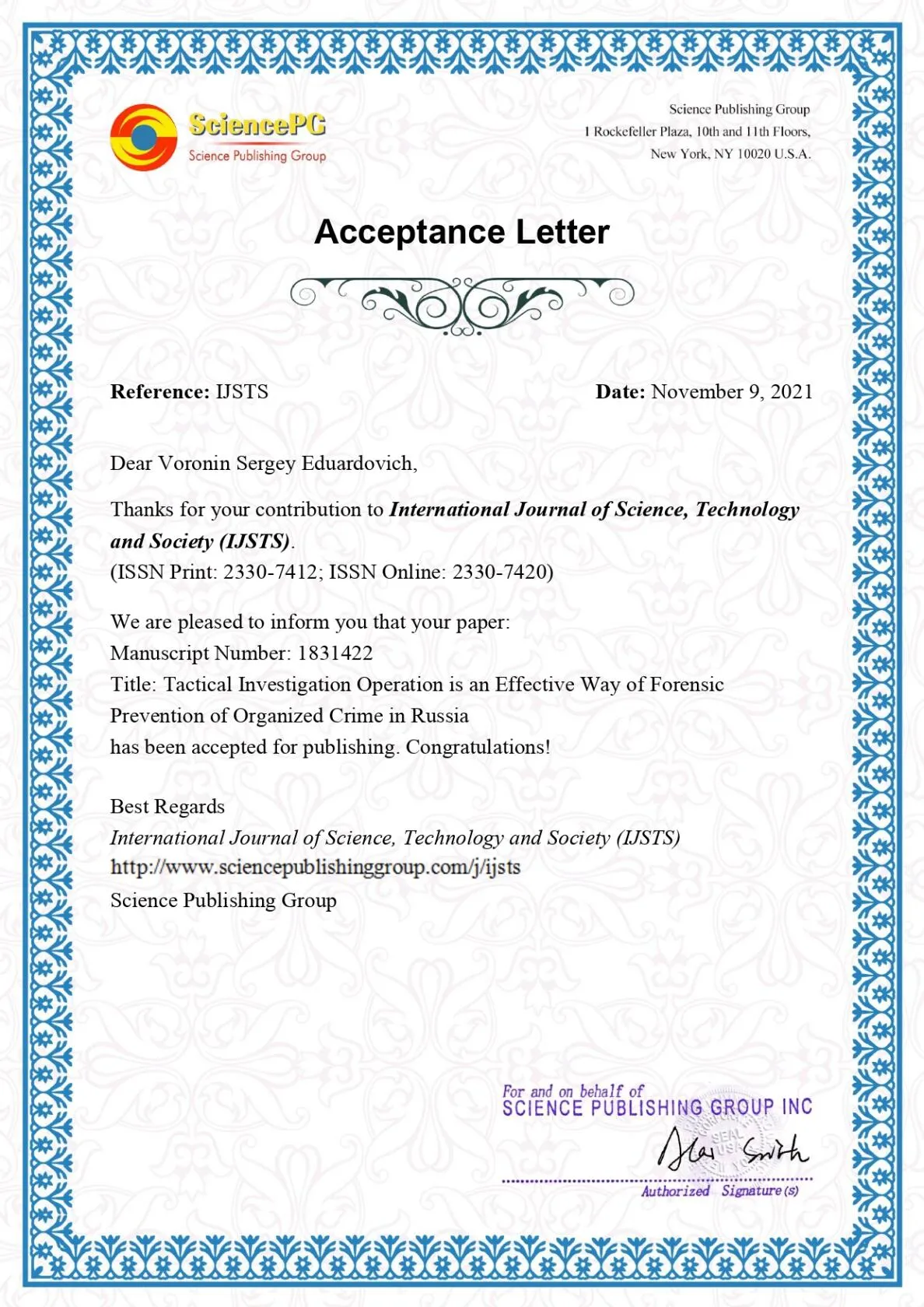
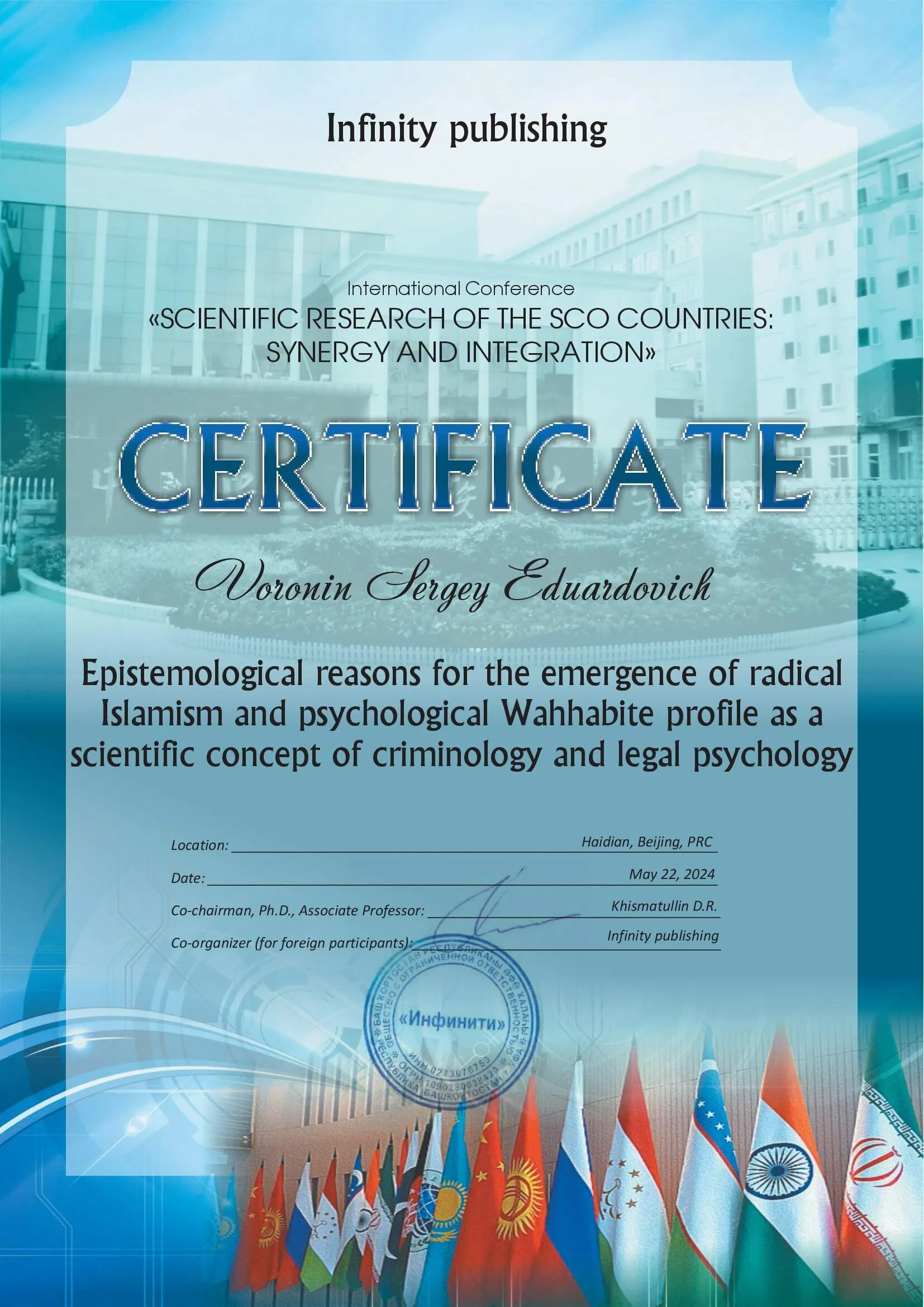
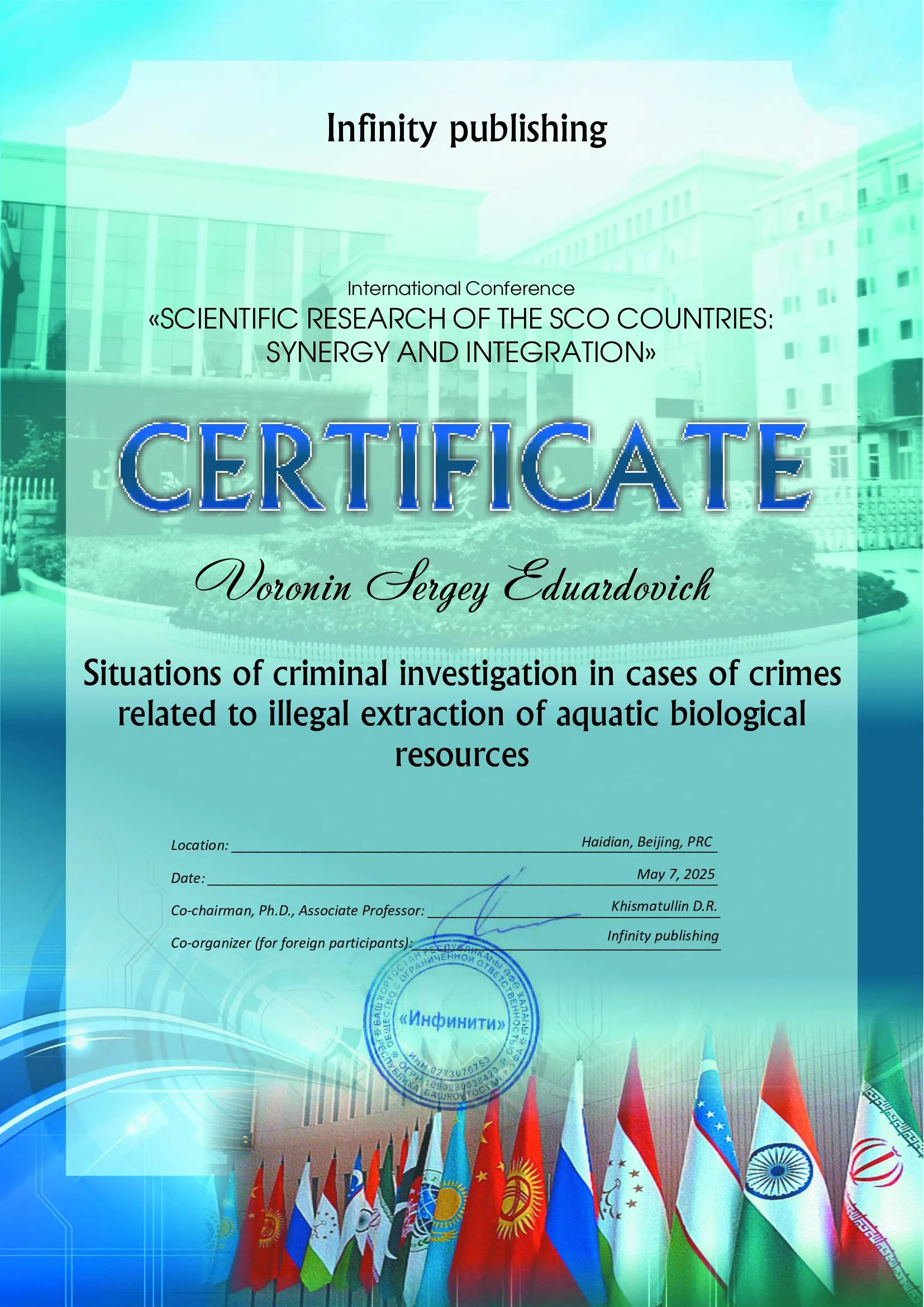
Воронин Сергей Эдуардович
Три статьи в журналах Scopus

Самиздат: [Регистрация] [Найти] [Рейтинги] [Обсуждения] [Новинки] [Обзоры] [Помощь|Техвопросы]
Links
Кожевенное мастерство: сумки, ремни своими руками
 Ваша оценка:
  • Аннотация:
    Три статьи профессора, доктора юридических наук Воронина С.Э. в зарубежные журналы Scopus


   0x01 graphic


   При
   0x01 graphic
  

0x01 graphic

  
   Обзор
   Журналы по темам
    Науки о жизни, сельское хозяйство и пищевая промышленность
    Химия
    Медицина и здравоохранение
    Материаловедение
    Математика и физика
    Электротехника и информатика
    Земля, энергетика и окружающая среда
    Архитектура и гражданское строительство
    Образование
    Экономика и менеджмент
    Гуманитарные и социальные науки
    Междисциплинарные
   Книги
   Опубликовать сборник тезисов конференции
   Сборник тезисов предстоящей конференции
   Сборник тезисов опубликованных конференций
   Опубликовать свои книги
   Сборник тезисов предстоящих конференций
   Опубликованные книги
   Труды
   Мероприятия
   Мероприятия
   Пять типов публикаций конференций
   Присоединиться
   Присоединиться в качестве главного редактора
   Присоединиться в качестве старшего редактора
   Присоединиться в качестве члена редакционной коллегии
   Стать рецензентом
   Информация
   Для авторов
   Для рецензентов
   Для редакторов
   Для организаторов конференций
   Для библиотекарей
   Плата за обработку статей
   Руководство по подготовке специальных выпусков
   Редакционный процесс
   Передача рукописей
   Рецензирование в SciencePG
   Открытый доступ
   Авторское право и лицензия
   Этические принципы
   Отправить статью
   Войти в систему Зарегистрироваться
  -- Домашний 
  --  архив 
  --  Том 9, выпуск 6
    | Рецензируемый
   Тактическая следственная операция - эффективный способ криминалистического предупреждения организованной преступности в России
   Воронин Сергей Эдуардович
   Международный журнал науки, технологий и общества, Опубликовано в (Том 9, выпуск 6)
   Получено: 21 октября 2021 г.     Принято: 9 ноября 2021 г.     Опубликовано: 17 ноября 2021 г.
   Просмотров: 2647      Скачиваний: 2246
   Скачать PDF
  
   Аннотация
   В статье рассматривается проблема криминалистической профилактики и ее роль в борьбе с организованной преступностью. Автор утверждает, что эта проблема особенно актуальна сейчас в России и во всем мире. Тактико-криминалистическое исследование, направленное на изучение тактических приемов по отдельности и в их сочетании, возможно только при наличии целостной картины системы тактических приемов. Мир находится в состоянии глубокого экономического и социального кризиса. Миграционные процессы охватили все страны. Организованная преступность в России становится этнической. Это усложняет борьбу с преступлениями против личности. Практика показывает, что этнические преступные сообщества высокоорганизованны и жестоки. Автор статьи анализирует тактическую операцию "Зонирование наиболее криминогенных районов города Красноярска". Эта тактическая операция была проведена в 2017 году сотрудниками отдела уголовного розыска Главного управления МВД по Красноярскому краю. В результате кропотливой работы, проведенной с использованием государственных и частных методов ОРД, была составлена карта криминальных зон, расположенных в самых популярных и модных ресторанах Красноярска. Впоследствии эта карта была опубликована сотрудниками уголовного розыска в интернете - во всех соответствующих социальных сетях. Таким образом, подводя итог сказанному, можно сделать обоснованный вывод о том, что криминалистическое зонирование как часть криминалистической профилактики принципиально отличается от криминологического зонирования. Очевидно, что основными критериями криминалистического зонирования являются не криминологические причины и условия, способствующие совершению преступления, а механизм и способы совершения преступления как криминалистические категории. Криминалист может провести тактическую операцию "зонирование преступных территорий" по способу и механизму совершения преступлений. Это могут быть не только рестораны и другие общественные места. В статье показан метод зонирования наиболее криминогенных зон браконьерства в Охотском и Японском морях. Автор статьи приходит к выводу, что тактическая операция "зонирование" является универсальной научной категорией криминалистики и криминологии. Судебно-профилактические и тактические следственные операции - эффективный способ борьбы с организованной этнической преступностью.
   Опубликовано в
   International Journal of Science, Technology and Society (Том 9, выпуск 6)
   DOI
   10.11648/j.ijsts.20210906.13
   Страница(и)
   275-280
   Creative Commons
   0x01 graphic
   Это статья в открытом доступе, распространяемая на условиях международной лицензии Creative Commons Attribution 4.0 (http://creativecommons.org/licenses/by/4.0/), которая разрешает неограниченное использование, распространение и воспроизведение в любом носителе или формате при условии, что на оригинальное произведение сделана соответствующая ссылка.
   Авторские права
   Авторские права (C) Автор(ы), 2021. Опубликовано издательством Science Publishing Group
   Предыдущая статья
   Следующая статья
   Ключевые слова
   Профилактика, криминалистика, этнос, бандиты, тактика, расследование, операция, зонирование
   Ссылки
   [1]
   Гавло В. К. Теория и практика расследования преступлений в сфере миграционной безопасности: Монография / В. К. Гавло, С. Е. Воронин, И. В. Никитенко, Красноярск: Издательство Сибирского института бизнеса, управления и психологии. 2020. - С. 236.
   [2]
   Воронин, С. Е. Психотипологический подход в системе судебно-экспертного знания: монография / С. Е. Воронин, Р. Л. Ахмедшин, Т. А. Алексеева. Красноярск: Издательство Сибирского института бизнеса, управления и психологии. 2018. С. 123.
   [3]
   Воронин, С. Е. Нравственно-психологические основы оперативно-розыскной деятельности и уголовного судопроизводства: Монография / С. Е. Воронин. - Красноярск: Издательство Сибирского института бизнеса, управления и психологии, 2018. - С. 114.
   [4]
   Воронин, С. Е. Организация преступного сообщества: уголовно-правовые и криминалистические аспекты / С. Е. Воронин, Е. С. Воронина, А. М. Железняков. - Красноярск: Издательство Сибирского института бизнеса, управления и психологии, 2020. - С. 214.
   [5]
   Воронин, С. Е. Диалоги об уголовном судопроизводстве в России: Монография / С. Е. Воронин. Хабаровск: Издательство Дальневосточного института МВД России. 2018. С. 126.
   [6]
   Воронин, С. Е. Ситуационное моделирование в судебной экспертизе [Текст] / С. Е. Воронин. - Красноярск: Издательство Красноярского государственного аграрного университета, 2018. - С. 121.
   [7]
   Воронин, С. Е. Актуальные проблемы современной криминалистики [Текст] / С. Е. Воронин, И. В. Никитенко, Д. А. Степаненко. - Красноярск: Издательство АНО ВО "Сибирский институт бизнеса, управления и психологии", 2020. - С. 102.
   [8]
   Воронин, С. Е. Теория и практика расследования преступлений, связанных с незаконным добыванием водных биологических ресурсов [Текст] / С. Е. Воронин, М. Н. Токарев. - Красноярск: Издательство Сибирского института бизнеса, управления и психологии, 2021. - С. 136.
   [9]
   Воронин, С. Е. Судебная экспертиза: практикум / учебное пособие / С. Е. Воронин. Красноярск: АНО ВО "Сибирский институт бизнеса, управления и психологии", 2018. - С. 99.
   [10]
   Воронин, С. Е. Топ-6 самых криминальных ресторанов Красноярска //Интернет-ресурсhttp://samlib.ru/w/woronin_sergej_eduardowich/book-12.shtml.
   [11]
   Воронин, С. Е. Бандиты города Красноярска // Интернет-ресурсhttps://www.youtube.com/watch?v=4rS3OFp9cw0.
   [12]
   Воронин, С. Е. Бандиты Красноярска! Они живут рядом с нами! https://www.youtube.com/watch?v=wwHg2dsIFj0&t=159s.
   [13]
   Akhmedshin R. L. Legal and methodological support of border activities. Monograph / R. L. Akhmedshin, S. E. Voronin. Krasnoyarsk: Publishing house of the Siberian Institute of Business, Management and Psychology. 2021. R. 146.
   [14]
   Воронин С. Э. Антикоррупционная тактика сотрудника полиции. 2020 http://samlib.ru/w/woronin_sergej_eduardowich/book-16.shtml
   [15]
   Воронин С. Э. Бандиты Красноярска. Обращение к Генеральному прокурору России. 2020 https://www.youtube.com/watch?v=zE9AyFoq8sc&t=734s
   [16]
   Этнические бандиты Красноярска. 2021 http://samlib.ru/w/woronin_sergej_eduardowich/book-25.shtml
   Цитируйте эту статью
   Обычный текстBibTeXRIS
  -- Стиль APA
   Воронин Сергей Эдуардович. (2021). Тактическая операция - эффективный способ криминалистического предупреждения организованной преступности в России. International Journal of Science, Technology and Society, 9(6), 275-280. https://doi.org/10.11648/j.ijsts.20210906.13
    | 
   Стиль ACS
   Воронин Сергей Эдуардович. Тактическая операция - эффективный способ криминалистического предупреждения организованной преступности в России. Int. J. Sci. Technol. Soc. 2021, 9(6), 275-280. doi: 10.11648/j.ijsts.20210906.13
    | 
   AMA Style
   Воронин Сергей Эдуардович. Тактическая следственная операция - эффективный способ криминалистического предупреждения организованной преступности в России. Международный научно-технический журнал . 2021;9(6):275-280.doi: 10.11648/j.ijsts.20210906.13
    | 
  -- @статья{10.11648/j.ijsts.20210906.13,
  -- автор = {Воронин Сергей Эдуардович},
  -- title = {Тактическая следственная операция - эффективный способ криминалистического предупреждения организованной преступности в России},
  -- журнал = {Международный журнал науки, технологий и общества},
  -- том = {9},
  -- номер = {6},
  -- страницы = {275-280},
  -- doi = {10.11648/j.ijsts.20210906.13},
  -- url = {https://doi.org/10.11648/j.ijsts.20210906.13},
  -- eprint = {https://article.sciencepublishinggroup.com/pdf/10.11648.j.ijsts.20210906.13},
  -- abstract = {В статье рассматривается проблема криминалистической профилактики и ее роль в борьбе с организованной преступностью. Автор утверждает, что эта проблема особенно актуальна сейчас в России и во всем мире. Тактико-криминалистическое исследование, направленное на изучение тактических приемов по отдельности и в их комбинациях, возможно только при наличии целостной картины системы тактических приемов. Мир находится в состоянии глубокого экономического и социального кризиса. Миграционные процессы охватили все страны. Организованная преступность в России становится этнической. Это осложняет борьбу с преступлениями против личности. Практика показывает, что этнические преступные сообщества высокоорганизованны и жестоки. Автор статьи анализирует тактическую операцию "Зонирование наиболее криминогенных районов города Красноярска". Эта тактическая операция была проведена в 2017 году сотрудниками отдела уголовного розыска Главного управления МВД России по Красноярскому краю. В результате кропотливой работы, проведенной с использованием государственных и частных методов ОРД, была составлена карта криминальных зон, расположенных в самых популярных и модных ресторанах Красноярска. Впоследствии эта карта была опубликована сотрудниками уголовного розыска в интернете - во всех соответствующих социальных сетях. Таким образом, подводя итог сказанному, можно сделать обоснованный вывод о том, что криминалистическое зонирование как часть криминалистической профилактики принципиально отличается от криминологического зонирования. Очевидно, что основными критериями криминалистического зонирования являются не криминологические причины и условия, способствующие совершению преступления, а механизм и способы совершения преступления как криминалистические категории. Криминалист может провести тактическую операцию "зонирование преступных территорий" по способу и механизму совершения преступлений. Это могут быть не только рестораны и другие общественные места. В статье показан метод зонирования наиболее криминогенных зон браконьерства в Охотском и Японском морях. Автор статьи приходит к выводу, что тактическая операция "зонирование" является универсальной научной категорией криминалистики и криминологии. Криминалистическая профилактика и тактические следственные операции - эффективный способ борьбы с организованной этнической преступностью.},
  -- год = {2021}
  -- }
  --  | 
  -- TY - JOUR
  -- T1 - Tactical Investigation Operation is an Effective Way of Forensic Prevention of Organized Crime in Russia
  -- AU - Voronin Sergey Eduardovich
  -- Y1 - 2021/11/17
  -- PY - 2021
  -- N1 - https://doi.org/10.11648/j.ijsts.20210906.13
  -- DO - 10.11648/j.ijsts.20210906.13
  -- T2 - International Journal of Science, Technology and Society
  -- JF - International Journal of Science, Technology and Society
  -- JO - International Journal of Science, Technology and Society
  -- SP - 275
  -- EP - 280
  -- PB - Science Publishing Group
  -- SN - 2330-7420
  -- UR - https://doi.org/10.11648/j.ijsts.20210906.13
  -- AB - The article examines the problem of forensic prevention and its role in the fight against organized crime. The author says that this problem is especially urgent now in Russia and around the world. Tactical and forensic research, focusing on the study of tactical techniques separately and in their combinations, is possible only when seeing a holistic picture of the system of tactical techniques. The world is in a state of deep economic and social crisis. Migration processes have captured all countries. Organized crime in Russia is becoming ethnic. This complicates the fight against crimes against the person. Practice shows that ethnic criminal communities are highly organized and brutal. The author of the article analyzes tactical operation "zoning of the most criminally prone areas of the city of Krasnoyarsk." This tactical operation was carried out in 2017 by officers of the Criminal Investigation Department of the Central Internal Affairs Directorate for the Krasnoyarsk Territory. As a result of painstaking work carried out with the help of public and private ORD methods, a map of the criminal zones located in the most popular and fashionable restaurants of the city of Krasnoyarsk was compiled. Subsequently, this map was posted by the criminal investigation officers on the Internet - in all relevant social networks. Thus, summarizing what has been said, we can make a reasonable conclusion that forensic zoning, as part of forensic prevention, is fundamentally different from criminological zoning. Obviously, the main criteria for forensic zoning are not criminological reasons and conditions conducive to the commission of a crime, but the mechanism and methods of crime as forensic categories. A forensic scientist can implement a tactical operation "zoning of criminal territories" according to the method and mechanism of committing crimes. It can be not only restaurants and other public places. The article demonstrates the zoning method for the most criminogenic zones of poaching of aquatic biological resources in the Sea of Okhotsk and the Sea of Japan. The author of the article concludes that the tactical operation "zoning" is a universal scientific category of forensic science and criminology. Forensic prevention and tactical investigation operations are an effective way to combat organized ethnic crime.
  -- VL - 9
  -- IS - 6
  -- ER -
    | 
   Информация об авторе
  -- Воронин Сергей Эдуардович
   Юридический факультет Сибирского института бизнеса, управления и психологии, Красноярск, Россия

Скачать PDF

Отправить статью

  -- Разделы
  -- Аннотация
  -- Ключевые слова
  -- Ссылки
  -- Цитирование
  -- Информация об авторе
   О нас
   Science Publishing Group (SciencePG) - издательство открытого доступа, выпускающее более 300 рецензируемых онлайн-журналов по широкому спектру научных дисциплин.
   Подробнее о SciencePG 
  
   Продукты
  -- Журналы
  -- Специальные выпуски
  -- Труды конференций
  -- Книги
  -- Научные мероприятия
  -- Научные профили
   Информация
  -- Для авторов
  -- Для рецензентов
  -- Для редакторов
  -- Для организаторов конференций
  -- Для библиотекарей
  -- Руководство по специальным выпускам
  -- Редакционный процесс
  -- Рецензирование в SciencePG
  -- Открытый доступ
  -- Этические принципы
  -- Плата за обработку статей
  -- Пожизненное индивидуальное членство
   Важная ссылка
  -- Подача рукописи
  --
  -- Стать членом редакционного совета
  -- Стать рецензентом
  -- Программа поддержки авторов

(C) 2012-2026 Science Publishing Group - все права защищены.

   0x08 graphic
0x01 graphic
   Tactical Investigation Operation is an Effective Way of Forensic Prevention of Organized Crime in Russia
   Voronin Sergey Eduardovich
   Faculty of Law, Siberian Institute of Business, Management and Psychology, Krasnoyarsk, Russia
   Email address:
   0x01 graphic
   To cite this article:
   Voronin Sergey Eduardovich. Tactical Investigation Operation is an Effective Way of Forensic Prevention of Organized Crime in Russia.
   International Journal of Science, Technology and Society. Vol. 9, No. 6, 2021, pp. 275-280. doi: 10.11648/j.ijsts.20210906.13
   Received: October 21, 2021; Accepted: November 9, 2021; Published: November 17, 2021

0x08 graphic
0x01 graphic

   Abstract: The article examines the problem of forensic prevention and its role in the fight against organized crime. The author says that this problem is especially urgent now in Russia and around the world. Tactical and forensic research, focusing on the study of tactical techniques separately and in their combinations, is possible only when seeing a holistic picture of the system of tactical techniques. The world is in a state of deep economic and social crisis. Migration processes have captured all countries. Organized crime in Russia is becoming ethnic. This complicates the fight against crimes against the person. Practice shows that ethnic criminal communities are highly organized and brutal. The author of the article analyzes tactical operation "zoning of the most criminally prone areas of the city of Krasnoyarsk." This tactical operation was carried out in 2017 by officers of the Criminal Investigation Department of the Central Internal Affairs Directorate for the Krasnoyarsk Territory. As a result of painstaking work carried out with the help of public and private ORD methods, a map of the criminal zones located in the most popular and fashionable restaurants of the city of Krasnoyarsk was compiled. Subsequently, this map was posted by the criminal investigation officers on the Internet - in all relevant social networks. Thus, summarizing what has been said, we can make a reasonable conclusion that forensic zoning, as part of forensic prevention, is fundamentally different from criminological zoning. Obviously, the main criteria for forensic zoning are not criminological reasons and conditions conducive to the commission of a crime, but the mechanism and methods of crime as forensic categories. A forensic scientist can implement a tactical operation "zoning of criminal territories" according to the method and mechanism of committing crimes. It can be not only restaurants and other public places. The article demonstrates the zoning method for the most criminogenic zones of poaching of aquatic biological resources in the Sea of Okhotsk and the Sea of Japan. The author of the article concludes that the tactical operation "zoning" is a universal scientific category of forensic science and criminology. Forensic prevention and tactical investigation operations are an effective way to combat organized ethnic crime.
   Keywords: Prevention, Forensics, Ethnos, Gangsters, Tactics, Investigation, Operation, Zoning

0x08 graphic
0x01 graphic

  
  -- Introduction to Forensic Science
   One of the controversial issues in the science of forensic science has been and remains the problem of forensic crime prevention. In fact, the problem here is the very formulation of the question of the possibility of existence within the framework of forensic science of such a legal phenomenon in parallel with criminological prevention. After all, the existence of criminological prevention has never raised doubts among any of the scientists. But then, in this case, there is a real danger of reductionism - that is, substitution and duplication of the subject of one scientific discipline with the subject of another. In this article, we will try to delimit the subjects of preventive activity in forensic science and criminology, as far as it is, in principle, possible.
   For the first time, scientists - lawyers started talking about the need to isolate a section on prevention within the framework of forensic science in the 70s of the last century. The founder of the concept of forensic prevention was Russian Professor V. K. Gavlo. [1] This concept has evoked rather sharp criticism from a number of scientists - criminologists - representatives of the so-called "old school of criminalistics" who came to science from law enforcement
   agencies. [5]
   So, L. Y. Drapkin at one time harshly criticized the very possibility of crime prevention by forensic means. According to Russian Professor L. Y. Drapkin, a criminologist always deals only with criminal events that have already taken place, working with traces of a crime, restoring the picture of a crime bit by bit, like a complex mosaic. Then what kind of prevention of future crimes can we talk about in such a
   situation? [7]
   Perhaps, one can agree with the argument given by L. Y. Drapkin. Indeed, the retrospective nature of forensic activity practically does not leave forensic science, as a science, a chance to compete with the complex crime prevention carried out in criminology. However, as you know, there is an exception to any rule. Such an exception to the general rule, in our opinion, is the tactical operation "zoning the most criminally prone areas of the city." [9]
  -- Tactical Operation Concept
   Tactical and forensic research, focusing on the study of tactical techniques separately and in their combinations, is possible only when seeing a holistic picture of the system of tactical techniques. At first glance, the tactics of conducting individual investigative actions today has a wide arsenal of tactical techniques, the optimization of which is seen either by the vector of individualization of tactical influence, which we considered earlier in the context of understanding the structural model of tactical technique, or by the vector of adaptation of knowledge of other sciences, which, due to the progressive development science and technology are a constant source of tactical innovation.
   However, even a cursory glance reveals that the system of tactics is not a meaningfully balanced sphere of knowledge. It is not surprising that, within the framework of tactical and forensic optimization of investigative activity, there are often recommendations that are so general in nature that one thinks about the extremely dismissive attitude of forensic
   researchers to the mental abilities of practitioners. [13]
   Indeed, what is the value of a tactical recommendation about the desirably maximum identity of the conditions of the investigative experiment being conducted and the conditions of the circumstances being verified by the investigator at the time of the crime? Is it really necessary to point out the advisability of this even in textbooks? What, the investigator himself will not come to an understanding of the advisability of creating a similarity of the situation?
   On the whole, we can safely state that a tactical technique that essentially boils down to "what to do?", In most cases, does not have the practical value that tactics that are contentoriented to the problem of deciding "how to do?" Have.
   Why is it that such naive tactical recommendations are found in the forensic literature of today?
   We see the answer to this question in the fact that researchers in the development of tactical methods do not have a conditional criterion for how much they should have a self-evident nature. The trouble is that this problem cannot be solved in the context of the analysis of the entire range of tactics developed by criminologists, but the need for this nevertheless exists.
   The foregoing predetermines the need to develop a certain hierarchy of tactical techniques, which, by the way, will immediately act as an indicator of the lack of the achieved results of the study of tactical techniques at specific levels.
   The hierarchy of tactical techniques involves the construction of a model that structurally includes three levels of generality of tactical techniques, which should include:
      -- general tactics - focused on the tactics of any investigative action;
      -- group tactics - focused on groups of investigative actions;
      -- tactical techniques of a specific investigative action - techniques, adapted sub-goals and objectives of a specific investigative action.
   Despite the fact that various investigative actions are different forms of activity, general tactics exist and form a fairly significant group, however, insufficiently studied in forensic science. The tactical techniques of the group under consideration are meaningfully aimed at solving the question: "how to maximally fulfill the requirements (scientific,
   specific, ethical, economical) for tactical techniques?"
   Group tactics are effective recommendations in the production of a group of investigative actions. We refer to independent groups of investigative actions as groups of communicative (interrogation, confrontation), search (investigative examination, search, seizure, examination), experimental (verification of testimony on the spot, investigative experiment, presentation for identification), research (examination, specialist research) investigative actions. We spoke earlier about the expediency of building just such a model of investigative actions. So, for example, the tactic of organizing breaks in order to restore the potential of attention of persons conducting a search is relevant both for the tactics of inspecting the scene of the incident and for the tactics of search.
   To understand the essence of forensic zoning, it is necessary to answer the conceptual question: what place does the category of "tactical operation" occupy in the scientific apparatus of modern forensic science? [6]
   For the first time, the Irkutsk scientist, criminologist Shikanov V. I. According to Russian Professor V. I. Shikanov, with whom one can agree, a tactical operation should be understood as a system of coordinated actions, including investigative actions and operational-search measures aimed
   at disclosing and investigating crimes. [4]
   This definition rightly emphasizes the role of operationalsearch measures in forensic activity, which, along with 16 investigative actions provided for by criminal procedure legislation, really help in the disclosure and investigation of crimes, equipping the criminologist with additional search and cognitive means of the operational search activity. [2]
   This is especially relevant at the present time, when the fight in the conditions of the existence of a well-organized criminal community in our country requires the mobilization of all forces and means at the disposal of the law enforcement agencies of modern Russia. [3]
   277 Voronin Sergey Eduardovich: Tactical Investigation Operation is an Effective Way of Forensic Prevention of
   Organized Crime in Russia
   Let us give a very successful, in our opinion, example of a tactical operation "zoning of the most criminally prone areas of the city of Krasnoyarsk." This tactical operation was carried out in 2017 by officers of the Criminal Investigation Department of the Central Internal Affairs Directorate for the Krasnoyarsk Territory. As a result of painstaking work carried out with the help of public and private ORD methods, a map of the criminal zones located in the most popular and fashionable restaurants of the city of Krasnoyarsk was compiled. Subsequently, this map was posted by the criminal investigation officers on the Internet - in all relevant social networks. [10]
  -- Zone Number 1. Grill-bar "Shashlykoff"
   Located at: st. 78 Volunteer brigade, 12. Is under the direct control of the current head of the Azerbaijani diaspora in Krasnoyarsk TalehSadi-ogluMamedov, who ascended the "throne" in December 2004 after the assassination of the head of the Azerbaijani community of Krasnoyarsk, MahirIlyasov, in which citizen Mamedov is suspected to this day.. The activities of the interethnic organized criminal group, which include Russians, Azerbaijanis and Kyrgyz, is described in detail in the essay "Top 6 most criminal restaurants in Krasnoyarsk." Represents a great public danger. This organized criminal group has long and very successfully been "covered" by the police of the Soviet district of the city of Krasnoyarsk.
  -- Zone Number 2. Pound of Honey Restaurant
   Located at: st. Takeoff, 12-a. Controlled by an Azerbaijani organized crime group. They specialize in clonidine. Prostitutes are actively used in work with potential victims. For a long time the "overseer" of the restaurant has been an Azeri 28-30 years old with an oriental beard named Edik. He always sits in the VIP booth to the right of the bar. You can see this booth in the presented photo. According to operational data, after a police check in October 2017, it was to this restaurant that the interethnic organized crime group described in the aforementioned criminal essay migrated from the Shashlykoff restaurant.
  -- Zone Number 3. Irish Pub "HaratsPub"
   Located at: st. Mate Zalki, 10 g. Controlled by an Armenian organized crime group, which appeared relatively recently in Krasnoyarsk and ousted Azerbaijanis from the part of the territory of the Severnymicrodistrict, adjacent to Mate Zalki and Shumyatsky streets. Armenians aged 30-35, natives of Yerevan and Nagorno-Karabakh. They sit down in a group of three not far from your tables and play quite noisy backgammon, choosing a convenient moment to toss clonidine into your glass of beer. They speak Russian poorly, in contrast to the local Azerbaijanis.
  -- Zone Number 4. Family Restaurant (Formerly "Boomerang") "Family Bar $ Kitchen"
   Located at the address: Shumyatsky, 2 also in the Severnymicrodistrict. For many years it has been controlled by an Azerbaijani organized crime group. The criminal repertoire is the same - prostitutes and clonidine.
  -- Zone Number 5. Irish pub "HaratsPub" (Pub # 20 on Lazo)
   Located at 53 Metallurgov Avenue. One of the most malicious and aggressive Azerbaijani criminal groups. They represent a great public danger. For a long time, the "overseer" of the pub has been a bald Azeri 30-35 years old named Alik. Be extremely careful and careful when visiting this drinking establishment in Krasnoyarsk. All the bartenders in the restaurants we have listed are bandit gunners. Of particular interest to them, of course, are single drinking bachelors.
  -- Zone 6. Belgian Restaurant "Bringing Down in Bruges"
   Located at: st. Aviatorov, 50. Since 2015, it has been tightly controlled by members of the Kyrgyz ethnic organized crime group. They specialize in robberies and robberies; they were also repeatedly noticed in the criminal activities of the socalled "black" realtors. It was from this restaurant of Belgian cuisine that a unique operational-tactical operation codenamed "Black Realtor" began in Krasnoyarsk in April 2017. At that time, a powerful interethnic organized criminal group headed by the Azerbaijani crime boss TalehSadi-ogluMamedov fell into the zone of operational development of the Krasnoyarsk criminal investigation officers. The tactical operation, as usual, began with the legendary event. The operative under the guise of a lonely drinking bachelor attracted the attention of the bartender of the restaurant "Lay Bottom in Bruges". After the restaurant, the operative was pursued right up to his house by members of an interethnic organized criminal group, which included Azerbaijanis, Russians and Kyrgyz. Under the terms of the legendary event, the drinking bachelor-widower was soon to sell a two-room apartment in the center of
   Krasnoyarsk. The criminals "took the bait", drove the operative into his apartment on the 9th floor of a residential building and set him under round-the-clock surveillance. The operative in this delicate situation had no choice but to record on a camera with a telescopic lens all the members of the gang who were circling near the house for almost a whole month. Subsequently, these photographs of the criminals were checked against the database of the criminal investigation department of the Krasnoyarsk Territory and, according to the tactical plan of the leaders of the operation, were posted on the Internet on the YouTube channel. However, soon the entire YouTube channel account, along with this video, was removed from the social network following a complaint from citizen of RussiaMamedovTaleh [11, 14-16].
   The basis for the complaint is a violation of community principles related to the inviolability of a citizen's private life. This is the so-called "evidence of behavior" of any criminal suspected of committing a grave and especially grave crime. But this circumstance did not stop the employees of the criminal investigation department. They duplicated the video "Bandits of Krasnoyarsk" on another YouTube account specially created for this purpose [12].
  -- The Role of a Tactical Investigation Operation in the Fight Against Organized Crime
   As a result of a successful tactical operation, about 150 members of the organized criminal group were identified and put on preventive records. The active accomplices of the "black realtors" were also identified - an employee of the management company and two corrupt police officers from the city of Krasnoyarsk, who provided cover for this criminal community.
   Considering the forensic value of not only the tactical recommendation itself, but also its optimization in relation to the circle of participants, in order to increase the efficiency of solving the problem of individualizing a tactical technique, it is advisable to include in its content:
      -- Algorithm of actions, the use of which with a high degree of probability will contribute to the achievement of forensically significant tasks. The content of this algorithm is described in detail in modern forensic literature, and there is no need to dwell on the content of scientific discussions, while not completely rejecting their relevance.
      -- Recommendations for clarifying the algorithm of actions based on the personal characteristics of the person who is affected. The recommendations under consideration are based on the personality characteristics of the affected person, expressed in strong / weak behavioral models inherent in him due to his psychological type.
      -- Recommendations for the refinement of the algorithm of actions based on the personal characteristics of the person exerting influence. The recommendations under consideration are based on the personality characteristics of the actor, expressed in strong / weak behavioral models inherent in him due to his psychological type. It seems that possible studies of the personality of the person conducting the investigation, focused on the study of psychological structures that determine the effectiveness of the tactical technique used, will form the basis for studies of the forensic characteristics of the personality of the investigator, which are in demand in domestic forensic science.
   For the sake of fairness, we note that studies of the personality of an investigator as a set of unique features in legal psychology were encountered back in the 1920s. It is likely that the result of such an understanding will be the realization that certain types of personality are not sufficiently capable of being realized in investigative activities, having a low tactical potential. Indeed, investigative activity is characterized by a number of factors that predetermine the effectiveness of the mental organization of investigators. It is difficult to argue with the fact that people with different types of psychological organization are equally effectively adapted to the entire spectrum of behavioral models. Thus, in our time, representatives of the criminal community have full access to the results of forensic research, bringing the value of forensic recommendations based on "investigative tricks" to the archaic level, designed for the most intellectually undeveloped part of crime.
   Having realized the limited effectiveness of "investigative cunning" tactics, it is necessary to return to the tradition of research based on:
      -- situational intellectual superiority of the investigator over another participant in the process, since permanent dominance is no longer achievable.
      -- a decrease in the protective potential of the outside affected due to poor awareness of certain manifestations of the psyche (social attitudes, physiological reactions, or other ways of stereotypical behavior). For example, even if the interviewee is familiar with the methods of detecting physiological reactions when constructing false readings, this knowledge will not determine his physiological reactions as not amenable to conscious control.
   Tactical methods of intellectual domination of the investigator over the interrogated are based on the correct use of the intellectual potential. If we cannot raise our intelligence in general, then we are quite capable of situationally optimizing it. The investigative action is divided into stages, within each of which the investigator implements a small number of cognitive tasks of the same type. This is the model of the tactical organization of the investigation, based on the situational intellectual superiority of the investigator over the antagonist.
   At the modern level of development of forensic knowledge, it is advisable to make this group of tactical techniques backbone for all investigative actions. As secondary tactics will act, aimed at reducing the protective potential of the affected due to their weak awareness, which will smooth out the effect of criminal "enlightenment" characteristic of the current stage of development of society. Tactics focused on "investigative tricks" become a kind of optional appendage, the use of which is determined by the current situation in the investigation and the creative nature of the investigator.
   The peculiarities of personality types predetermine rather strict boundaries for the implementation of professional qualities, but a kind of psychological specialization arising from each personality type can act as the sphere of professional activity in which a specific personality type will be revealed to the maximum extent, realizing the model of a modern reading of the concept of the investigator's tactical repertoire.
   Traditionally, opponents of the structural model of personality in criminology substantiate their position with two main arguments, which it is advisable to bring along with our counterarguments.
   279 Voronin Sergey Eduardovich: Tactical Investigation Operation is an Effective Way of Forensic Prevention of
   Organized Crime in Russia
   Argument 1. Personal characteristics cannot act as forensic matter. Counter-argument - it is inappropriate in forensic science to study the techniques and means of effective influence on the participants in the investigation, and in another science - the means that optimize this effect, since interdisciplinary "dispersion" will lead to the fact that a specific issue will not be adequately investigated in any of the sciences ...
   We are deeply convinced that it is the borrowing of applied psychological knowledge that is the main trend in the development of forensic tactics and forensic methods for investigating certain types of crimes, which arose at the dawn of forensic science. Let us recall that in the countries of Europe and America, legal psychology (law psychology) includes a wide range of patterns, which in our country are partially investigated within the framework of forensic tactics, but even there among criminologists the discussion "Are we really a science?" ... The study of the tactical forensic component without the integration of psychological knowledge today is nonsense and, unfortunately, is a feature characteristic of domestic forensic tactics, balancing the balance of "applied science vs. pure science "towards the latter.
   Argument 2. A tactical technique is a recommendation to the investigator, formulated in a rather general form, for the purpose of further concretization in the process of reading the features of the investigation of a particular crime. Counterargument - when considering the model of tactical technique not through the prism of "general laws - a particular case", but within the framework of the triunity "general laws - particular laws - a particular case", the value of the idea of increasing the tactical arsenal becomes rational.
   Individualization of a tactical technique will contribute, first of all, to its deeper scientific understanding, and at the applied level - to more effective application. We are deeply convinced that the formation of domestic forensic science is not a reason for abandoning the practice of tactical recommendations within the framework of the typological approach, so natural
   for foreign science of investigations. [13]
   Note that fraudulent transactions with real estate today are the main method of crimes committed by members of organized crime groups in modern criminal Russia. This is evidenced by both ruthless judicial statistics and high-profile trials against gangs of "black" realtors in Moscow, Irkutsk, Novosibirsk and Khabarovsk. [14]
   For example, as of August 1, 2018, in the Soviet district of the city of Krasnoyarsk, 2 abandoned apartments were discovered, the owners of which have been missing for about a year. The law enforcement agencies of Krasnoyarsk seized these apartments, stopping the criminal transactions in time, almost at the stage of their notarization. This was done at the request of the relatives of the missing persons - the owners of the apartments. And again, persons of Azerbaijani nationality were noticed in criminal scams with these apartments.
  -- Conclusion
   In conclusion, we note that forensic zoning can be carried out not only in settlements.
   So, within the framework of his dissertation research on the methods of investigating crimes related to the illegal extraction of aquatic biological resources, M. N. Tokarev conducted a very successful zoning of the areas of the Sea of Japan and the Sea of Okhotsk, which are most susceptible to attacks by foreign poachers, by the method of criminal
   fishing for seafood delicacies. [8]
   Thus, summarizing what has been said, we can make a reasonable conclusion that forensic zoning, as part of forensic prevention, is fundamentally different from criminological zoning. Obviously, the main criteria for forensic zoning are not criminological reasons and conditions conducive to the commission of a crime, but the mechanism and methods of crime as forensic categories.
   The problem of forensic prevention is relevant for the modern forensic, science. Especially in the context of the fight against organized ethnic crime. The problem of a tactical investigation operation is scientifically promising. Therefore, this problem needs further development.
   0x08 graphic
0x01 graphic
   References
      -- Gavlo V. K. Theory and practice of investigating crimes in the field of migration security: Monograph / V. K. Gavlo, S. E. Voronin, I. V. Nikitenko, Krasnoyarsk: Publishing house of the Siberian Institute of Business, Management and Psychology. 2020.-P. 236.
      -- Voronin, S. E. Psychotypological approach in the system of forensic knowledge: Monograph / S. E. Voronin, R. L. Akhmedshin, T. A. Alekseeva. Krasnoyarsk: Publishing house of the Siberian Institute of Business, Management and Psychology. 2018. P. 123.
      -- Voronin, S. E. Moral and psychological foundations of operational-search activity and criminal proceedings: Monograph / S. E. Voronin. - Krasnoyarsk: Publishing house of the Siberian Institute of Business, Management and Psychology, 2018.- P. 114.
      -- Voronin, S. E. Organization of a criminal community: criminal-legal and criminalistic aspects / S. E. Voronin, E. S. Voronina, A. M. Zheleznyakov. - Krasnoyarsk: Publishing house of the Siberian Institute of Business, Management and Psychology, 2020. - P. 214.
      -- Voronin, S. E. Dialogues about criminal proceedings in Russia: Monograph / S. E. Voronin. Khabarovsk: Publishing house of the Far Eastern Institute of the Ministry of Internal Affairs of the Russian Federation. 2018. P. 126.
      -- Voronin, S. E. Situational modeling in forensic examination [Text] / S. E. Voronin. - Krasnoyarsk: Publishing house of the Krasnoyarsk State Agrarian University, 2018.-P. 121.
      -- Voronin, S. E. Actual problems of modern forensic science [Text] / C. E. Voronin, I. V. Nikitenko, D. A. Stepanenko. - Krasnoyarsk: Publishing house of ANO VO "Siberian Institute of Business, Management and Psychology", 2020. -P. 102.
      -- Voronin, S. E. Theory and Practice of Investigation of Crimes Associated with Illegal Extraction of Aquatic Biological
   Resources [Text] / S. E. Voronin, M. N. Tokarev. - Krasnoyarsk: Publishing house of the Siberian Institute of Business, Management and Psychology, 2021.-P. 136.
      -- Voronin, S. E. Forensic Science: Workshop / Study Guide / S. E. Voronin. Krasnoyarsk: ANO VO "Siberian Institute of Business, Management and Psychology", 2018. - P. 99.
      -- Voronin, S. E. Top 6 most criminal restaurants in Krasnoyarsk //Internetresourcehttp://samlib.ru/w/woronin_sergej_eduardow ich/book-12.shtml.
      -- Voronin, S. E. Bandits of the city of Krasnoyarsk // Internet resourcehttps://www.youtube.com/watch?v=4rS3OFp9cw0.
      -- Voronin, S. E. Gangsters of Krasnoyarsk! They live next to us! https://www.youtube.com/watch?v=wwHg2dsIFj0&t=159s.
      -- Akhmedshin R. L. Legal and methodological support of border activities. Monograph / R. L. Akhmedshin, S. E.
  
   Voronin. Krasnoyarsk: Publishing house of the Siberian Institute of Business, Management and Psychology. 2021. R. 146.
      -- Voronin, S. E. Police Officer Anti-Corruption Tactics. 2020 http://samlib.ru/w/woronin_sergej_eduardowich/book-

   16.shtml
      -- Voronin, S. Е. Gangsters of Krasnoyarsk. Appeal to the
   Prosecutor General of Russia. 2020
   https://www.youtube.com/watch?v=zE9AyFoq8sc&t=734s
      -- Ethnic gangsters of Krasnoyarsk. 2021 http://samlib.ru/w/woronin_sergej_eduardowich/book-
   25.shtml
   0x08 graphic
0x01 graphic
   Tactical Investigation Operation is an Effective Way of Forensic Prevention of Organized Crime in Russia
   Voronin Sergey Eduardovich
   Faculty of Law, Siberian Institute of Business, Management and Psychology, Krasnoyarsk, Russia
   Email address:
   0x01 graphic
   To cite this article:
   Voronin Sergey Eduardovich. Tactical Investigation Operation is an Effective Way of Forensic Prevention of Organized Crime in Russia.
   International Journal of Science, Technology and Society. Vol. 9, No. 6, 2021, pp. 275-280. doi: 10.11648/j.ijsts.20210906.13
   Received: October 21, 2021; Accepted: November 9, 2021; Published: November 17, 2021

0x08 graphic
0x01 graphic

   Abstract: The article examines the problem of forensic prevention and its role in the fight against organized crime. The author says that this problem is especially urgent now in Russia and around the world. Tactical and forensic research, focusing on the study of tactical techniques separately and in their combinations, is possible only when seeing a holistic picture of the system of tactical techniques. The world is in a state of deep economic and social crisis. Migration processes have captured all countries. Organized crime in Russia is becoming ethnic. This complicates the fight against crimes against the person. Practice shows that ethnic criminal communities are highly organized and brutal. The author of the article analyzes tactical operation "zoning of the most criminally prone areas of the city of Krasnoyarsk." This tactical operation was carried out in 2017 by officers of the Criminal Investigation Department of the Central Internal Affairs Directorate for the Krasnoyarsk Territory. As a result of painstaking work carried out with the help of public and private ORD methods, a map of the criminal zones located in the most popular and fashionable restaurants of the city of Krasnoyarsk was compiled. Subsequently, this map was posted by the criminal investigation officers on the Internet - in all relevant social networks. Thus, summarizing what has been said, we can make a reasonable conclusion that forensic zoning, as part of forensic prevention, is fundamentally different from criminological zoning. Obviously, the main criteria for forensic zoning are not criminological reasons and conditions conducive to the commission of a crime, but the mechanism and methods of crime as forensic categories. A forensic scientist can implement a tactical operation "zoning of criminal territories" according to the method and mechanism of committing crimes. It can be not only restaurants and other public places. The article demonstrates the zoning method for the most criminogenic zones of poaching of aquatic biological resources in the Sea of Okhotsk and the Sea of Japan. The author of the article concludes that the tactical operation "zoning" is a universal scientific category of forensic science and criminology. Forensic prevention and tactical investigation operations are an effective way to combat organized ethnic crime.
   Keywords: Prevention, Forensics, Ethnos, Gangsters, Tactics, Investigation, Operation, Zoning

0x08 graphic
0x01 graphic

  
  -- Introduction to Forensic Science
  
   One of the controversial issues in the science of forensic science has been and remains the problem of forensic crime prevention. In fact, the problem here is the very formulation of the question of the possibility of existence within the framework of forensic science of such a legal phenomenon in parallel with criminological prevention. After all, the existence of criminological prevention has never raised doubts among any of the scientists. But then, in this case, there is a real danger of reductionism - that is, substitution and duplication of the subject of one scientific discipline with the subject of another. In this article, we will try to delimit the subjects of preventive activity in forensic science and criminology, as far as it is, in principle, possible.
   For the first time, scientists - lawyers started talking about the need to isolate a section on prevention within the framework of forensic science in the 70s of the last century. The founder of the concept of forensic prevention was Russian Professor V. K. Gavlo. [1] This concept has evoked rather sharp criticism from a number of scientists - criminologists.
  
   Статья С.Э. Воронина в научный журнал США http://ijsts.net/article/10.11648/j.ijsts.20210906.13


   International Journal of Science, Technology and Society 2021; 9(6): 275-280 276


   International Journal of Science, Technology and Society 2021; 9(6): 275-280 276


   International Journal of Science, Technology and Society


   ; 9(6): 275-280
  
   2021
  
   http://www.sciencepublishinggroup.com/j/ijsts
  
   doi: 10.11648/j.ijsts.20210906.13
  
   ISSN: 2330-7412 (Print); ISSN: 2330-7420 (Online)


   International Journal of Science, Technology and Society


   ; 9(6): 275-280
  
   2021
  
   http://www.sciencepublishinggroup.com/j/ijsts
  
   doi: 10.11648/j.ijsts.20210906.13
  
   ISSN: 2330-7412 (Print); ISSN: 2330-7420 (Online)


 Ваша оценка:

Связаться с программистом сайта.

Новые книги авторов СИ, вышедшие из печати:
О.Болдырева "Крадуш. Чужие души" М.Николаев "Вторжение на Землю"

Как попасть в этoт список

Кожевенное мастерство | Сайт "Художники" | Доска об'явлений "Книги"